






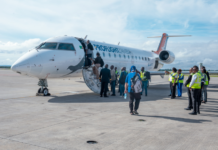





The current Ebola outbreak in the DRC has not grounded South African corporate travel. FCM, one of the world’s largest corporate travel management companies, has reported that cancellations for business travel into Africa are almost non-existent.
The reason, according to Mummy Mafojane, General Manager of FCM Southern Africa, is a more seasoned South African business traveller relying on muscle memory from the COVID pandemic.
“COVID put every South African business traveller through an intensive education in travel risk: reading advisories, understanding what their insurance actually covers, knowing who to call when an itinerary falls apart. That knowledge doesn’t disappear between crises. When an Ebola alert comes through, our clients don’t reach for the cancel button. They ask the right questions. That’s a completely different starting point,” she explains.
Africa already had prior experience with Ebola. The West African crisis of 2014 to 2016 and the DRC outbreak of 2018 to 2020 stress-tested the continent’s travel managers before COVID arrived. What the COVID pandemic added was scale and personal exposure: for the first time, every traveller in every market had to personally navigate entry requirements, refund claims, insurance conditions, and advisories that changed within hours. South African business travellers learned all of it, under pressure.
Those skills didn’t expire when borders reopened.
From blanket bans to surgical adjustments
The defining feature of pre-2020 outbreak response was its bluntness. Whole regions were placed on red lists. An Ebola case in Liberia would trigger cancellations across sub-Saharan Africa, regardless of geography. The tools available to travel managers were not built for precision, and so they defaulted to the only instrument they had: stop everything.
What has emerged since is a fundamentally different operating model. “The shift we’ve seen is from blanket responses to surgical ones. When an Ebola alert is issued today, the question is no longer ‘do we stop all travel to the continent?’ It’s ‘which of our travellers are within a meaningful distance of the affected zone, and what do we do specifically for them?’ That’s a completely different way of working,” says Mafojane.
Dynamic tracking sits at the centre of it. Travel management platforms now maintain a live picture of where every managed traveller is at any given moment, cross-referenced against a continuously updated map of global advisories, health alerts, and security incidents. When a region is reclassified, the system already knows whether anyone is there. The travel manager doesn’t need to send a company-wide email asking people to check in. Affected individuals are identified automatically, and their options are already being assessed.
If a zone in northern Italy is flagged as a new hotspot, the platform knows within minutes which business travellers are in it. Not the country. The zone.
The South African traveller who genuinely upskilled
The infrastructure story is only half of it. The other half is the traveller. “What we’re seeing is a traveller who has genuinely upskilled. COVID was an intensive, involuntary masterclass in travel risk management. Our clients came out of it knowing their rights, understanding the difference between a travel advisory level and an outright ban, and trusting that with the right support structure in place, they can navigate most situations,” says Mafojane.
This attitude to risk shows up in a specific and telling way: South African corporate travellers are now asking the right questions before they travel, not after something has gone wrong. What is the current advisory level for my destination? Does my insurance cover outbreak-related disruption specifically? What are my entitlements if my airline makes a significant schedule change? What is the emergency line?
These are no longer questions that surface in a crisis. They are pre-travel standard practice for the traveller and for the travel manager alike.
The safety net that’s already deployed
Much of what has changed in corporate travel risk management is invisible to travellers precisely because it’s working.
Medical assistance partnerships now provide 24-hour support for travellers facing health emergencies abroad, including repatriation coordination that would previously have required days of negotiation. Travel insurance has been substantially revised since 2020, with outbreak and conflict scenarios now explicitly addressed rather than buried in exclusion clauses. Duty-of-care obligations – once a vague principle in corporate policy documents – have become operational realities with defined response protocols and technology to back them.
“What gives travellers confidence is knowing that the safety net is already deployed, they don’t have to activate it themselves. The tracking is live. The alerts are automated. The emergency line is staffed. Before they’ve even landed, the system is already watching the environment around them,” says Mafojane.
The result is a market that responds to Ebola news the way a seasoned pilot responds to turbulence: with attention, adjustment, and without panic. The blanket corporate travel ban is becoming an artefact of an era before the industry knew better.